
What are Milestones?
Milestones help care providers create structured care plans by organizing client progress into three connected parts:
- Challenges — long-term outcomes the client is working toward
- Goals — shorter-term milestones that support a Challenge
- Tasks — specific actions that help the client make progress
Together, Challenges, Goals, and Tasks help break larger outcomes into smaller, more manageable steps.
This structure gives care providers a clear way to plan, track, and support progress over time, while helping clients stay engaged in their own journey.
Why Milestones matter
Milestones help care teams:
- Break long-term outcomes into manageable steps
- Create clearer care plans
- Support client accountability
- Track progress over time
- Improve coordination across providers
- Help clients understand what they are working toward
- Connect day-to-day actions to larger outcomes
Instead of keeping progress abstract, Milestones make the next step clear.
How the structure works
Milestones are designed to work as a hierarchy: Challenge → Goal → Task
Each level has a different purpose.
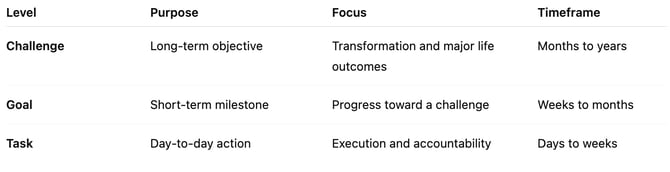
1. Challenges
Challenges represent larger, long-term outcomes a client is working toward.
These are usually meaningful changes that may take sustained effort, time, and support. A Challenge can represent something the client is trying to overcome, complete, build, or achieve.
Examples of Challenges:
- Finding employment
- Completing a housing program
- Building emotional regulation skills
- Reconnecting with a support system
- Working toward independent living
2. Goals
Goals break a Challenge into smaller, achievable milestones.
A Goal should be specific enough to guide progress, but broad enough to represent a meaningful step toward the larger Challenge.
Example of a Goal:
If the Challenge is: Finding employment
A related Goal could be: Create a resume
3. Tasks
Tasks are the specific actions a client can complete to make progress on a Goal.
Tasks are usually practical, concrete, and time-based. They may include appointments, deadlines, reminders, or day-to-day action items.
Example of a Task:
If the Goal is: Create a resume
A related Task could be: Attend resume-building session on Thursday at 2:00 PM
FAQ
Can Challenges, Goals, and Tasks be used independently?
Yes.
While the recommended structure is Challenge → Goal → Task, care providers can also assign Challenges, Goals, or Tasks independently when that better fits the client’s needs or the organization’s workflow.
For example, a care provider may assign a standalone Task for a one-time appointment, or a standalone Goal that does not need to be connected to a larger Challenge.
Milestones are flexible so organizations can adapt them to their own programs, service models, and client needs.
How Milestones become client assignments
Milestones are not automatically linked to a client.
A Challenge, Goal, or Task only becomes part of a client’s care plan when it is assigned directly from the client’s profile. Once assigned, that item becomes a client-specific assignment that care providers can track over time.
When the Coming Home mobile app launches, clients will be able to view their assigned Challenges, Goals, and Tasks in the app. Until then, Milestones are managed by care providers within the web platform.
Note: Starting in July 2026, clients will be able to view their assigned Challenges, Goals, and Tasks in the Coming Home mobile app. Until mobile app access is available, assigned Milestones are only visible to care providers within the web platform.
Related Articles
Need more help?
If you need help using Milestones, contact your Organization Administrator or reach out to the Coming Home Support Team through the in-platform chat and select Report an issue.