
What this feature does
Assessments are designed to evaluate a client’s progress within the context of a specific program enrollment. Rather than existing independently, assessments are intrinsically linked to the services a client receives in a particular program. This ensures that all data reflects the client’s journey, outcomes, and impact in the correct service context.
By capturing information at key stages: Entry, During, and Exit assessments provide a structured and longitudinal view of client progress over time.
Why assessments are program-based
Assessments only function inside programs because client outcomes are most meaningful when evaluated in relation to the services provided. Linking assessments to program enrollments allows organizations to:
- Track progress in context – Outcomes are directly associated with the specific services a client receives.
- Preserve historical data – Clients may participate in multiple programs, and each program maintains its own assessment history.
- Support accurate reporting – Program-level data enables reliable outcome measurement for funders and stakeholders.
- Enable before-and-after comparisons – Entry and Exit assessments provide measurable evidence of program impact.
- Improve service planning – Ongoing (“During”) assessments help teams adjust interventions based on client needs.
- Ensure compliance – Program-based assessments align with HMIS and Continuum of Care (CoC) requirements.
Assessment stages within a program
Each assessment corresponds to a specific moment in the client’s participation in a program:
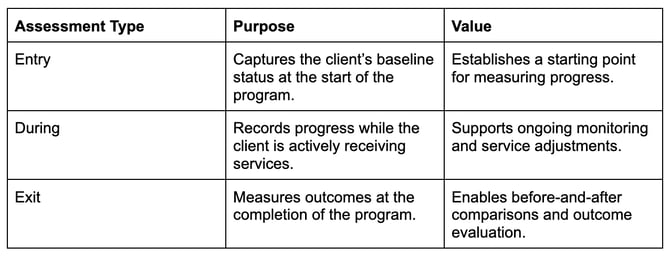
These standardized stages create a timeline of change, allowing organizations to understand the effectiveness of their interventions.
Key assessment domains
Program-based assessments evaluate client well-being across three core domains:
1. Living Situation & Needs
Assesses housing stability and immediate service needs, including prior and current living situations, household context, and translation requirements.
2. Employment & Income
Evaluates economic stability through education status, employment, income sources, and access to non-cash benefits.
3. Health & Disabilities
Captures health coverage, experiences of domestic violence, and the presence of disabling conditions.
Together, these domains provide a holistic understanding of a client’s circumstances and progress within a program.
Who can use this feature
- Organization Administrators – Can add, edit, archive, and view assessments.
- Team Members – Can manage assessments for clients assigned to them.
- Interns / Volunteers – Can manage assessments for assigned clients.
- Law Enforcement / Victim Advocates – Do not have access to program-based assessments.
Where assessments are located
Assessments are accessed within the Client Toolkit and are tied to a specific program enrollment. Each program maintains its own set of assessments, ensuring that client progress is evaluated within the appropriate service context.
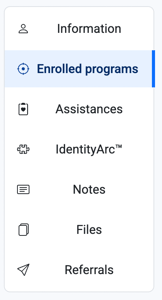
The Program-Based Assessments Dashboard provides:
- Program Context Header – Displays the program name and dates.
- Assessment Timeline – Lists Entry, During, and Exit assessments.
- Recorded By Information – Identifies the staff member responsible for each assessment.
- Centralized View – Enables teams to monitor progress and outcomes within the program.
Why this matters
Using assessments at the program level allows organizations to:
- Measure program effectiveness and client outcomes.
- Demonstrate impact to funders and stakeholders.
- Support data-driven decision-making.
- Ensure compliance with HMIS and CoC standards.
- Maintain clear and contextual client histories.
- Enhance service coordination and quality.
Without program-based assessments, it would be difficult to accurately attribute client outcomes to the services provided.
Tips / Best Practices
- Conduct Entry assessments promptly to establish an accurate baseline.
- Use During assessments to monitor progress and adjust services as needed.
- Complete Exit assessments to measure final outcomes and program impact.
- Ensure data accuracy and completeness to support reliable reporting.
- Leverage assessment insights for program evaluation and continuous improvement.
Related Articles
- Overview of Assessments
- How to Add an Assessment to a Client
- How to Edit or Update an Assessment
- Overview of Programs
Need more help?
If you need assistance understanding or using program-based assessments, please contact your Organization Administrator or reach out to our Support Team through the in-platform chat and select “Report an issue.”